
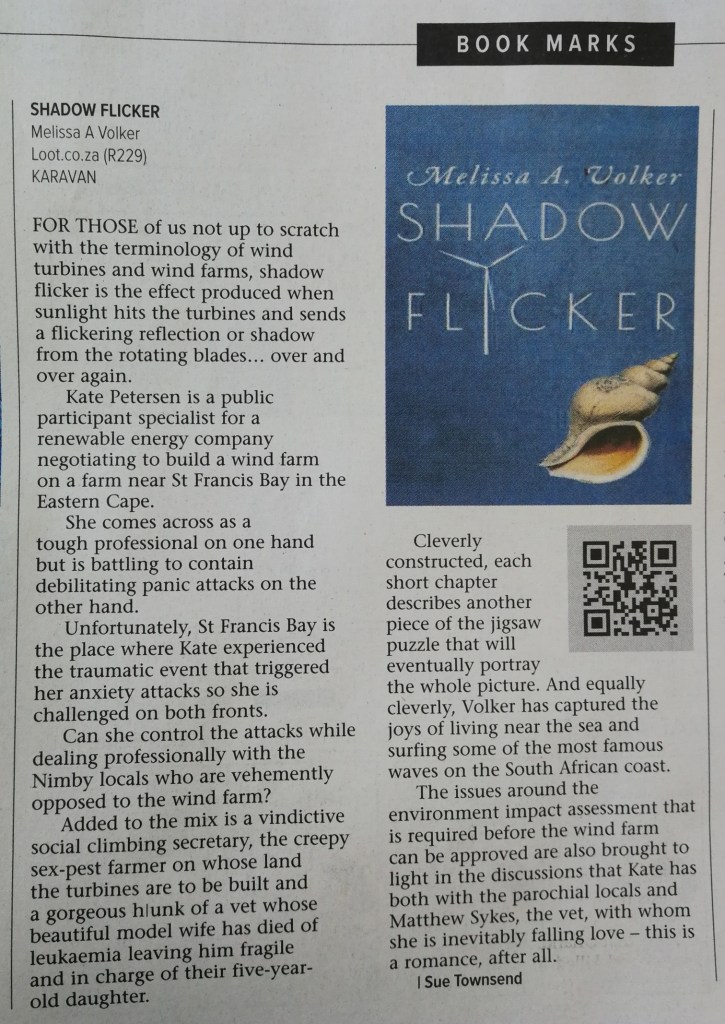
 Cape Times, 12 July 2019
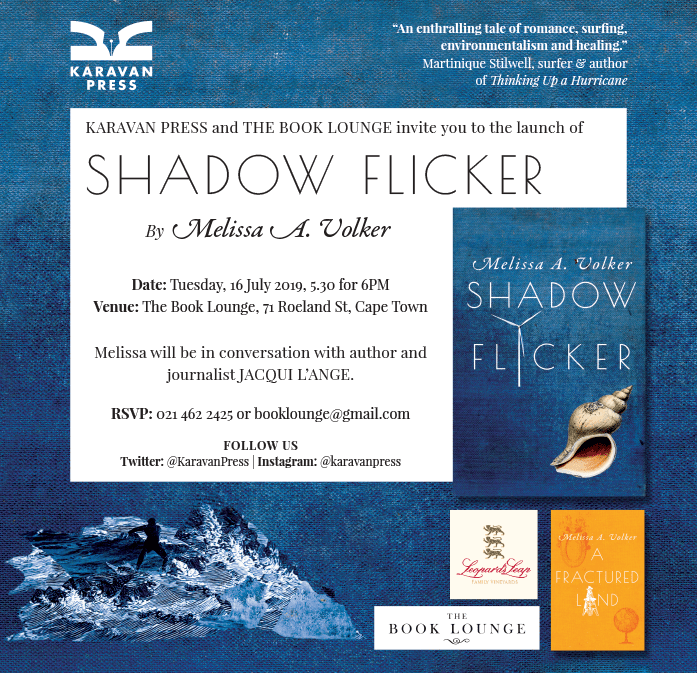
Book delivery: A Fractured Land and Shadow Flicker by Melissa A. Volker

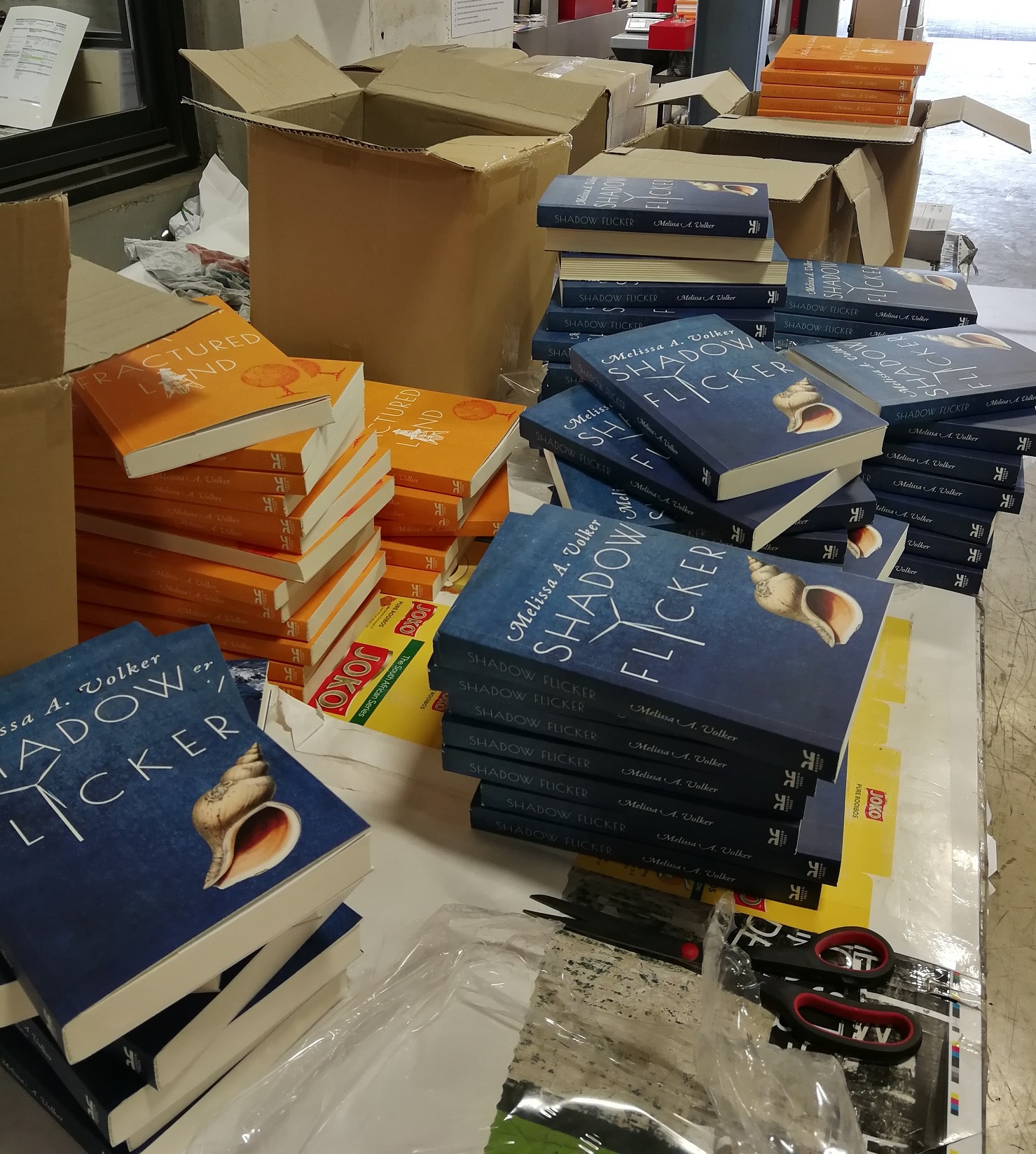
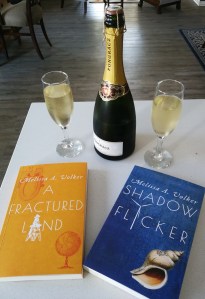 It is always a magical moment: holding your first book copies in your hands. They never feel entirely real, but the joy that is bubbling inside you is overwhelming so, always. Yesterday, that moment was particularly exuberant because Melissa and I were experiencing it together: she as author, I as publisher. Karavan Press’s first ever titles: A Fractured Land and Shadow Flicker.
 After the initial trouble with the binding of the first printrun, the second turned out to be perfect and so worth waiting for. The delay was daunting and frustrating, but both Melissa and I knew that what we had imagined for these novels had to become reality in order for us to be able to share them with our readers with all the exhilaration these special books deserve. And now, they are here. And they are everything we have wanted them to be.
 We hope to see the first copies in bookshops countrywide sometime next week, and we hope to see many enthusiastic readers at the launch of Shadow Flicker at the Book Lounge on 16 July. Melissa will be in conversation with the fabulous author and journalist, Jacqui L’Ange.
The feline community is already reading and we have the first paw of approval from Salieri, one of our literary cats. We can’t wait to see what Melissa’s Frosty has to say.
Karavan Press to publish Lester Walbrugh’s debut collection of short stories
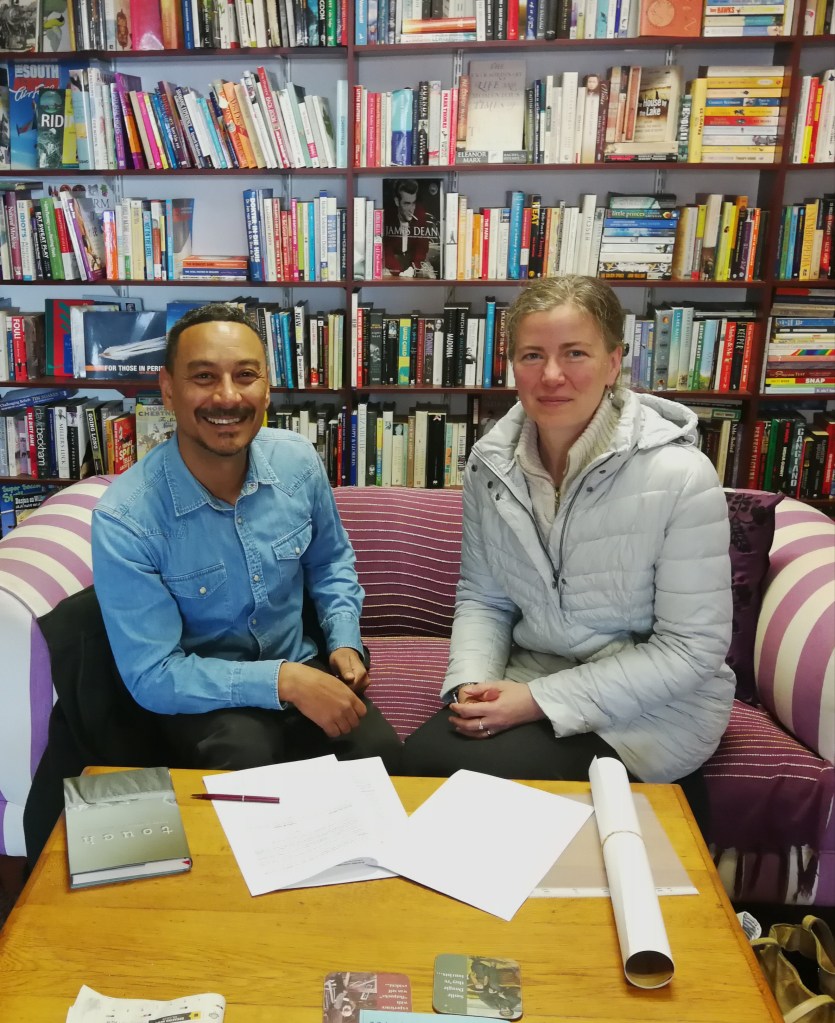
Karavan Press is excited to announce that we will be publishing the debut short story collection by the excellent local writer Lester Walbrugh. We signed the agreement last week at Liberty Books, a cosy bookshop in Grabouw, Lester’s hometown.
Lester’s short stories have been published in several anthologies and literary magazines. This year, his “The Space(s) Between Us” has made the longlist of the prestigious Short Story Day Africa Prize and will feature in the SSDA anthology, Hotel Africa; and his “Hairs and Graces” will be published in Hair: Weaving and Unpicking Stories of Identity in September. We look forward to putting together a selection of his best published and new work and sharing it with lovers of the short story. Watch this space for further details!
Author: Lester Walbrugh
 LESTER WALBRUGH is from Grabouw in the Western Cape. His acclaimed short stories have been published in, among others, the anthologies of Short.Sharp.Stories and Short Story Day Africa, New Contrast and, most recently, Hair: Weaving & Unpicking Stories of Identity. He has lived in the UK and Japan and is currently back in his hometown. Let It Fall Where It Will is his debut short story collection. Elton Baatjies is his first novel.
Author photograph by Francois F. Swanepoel.
Melissa A. Volker at the Montagu Book Festival
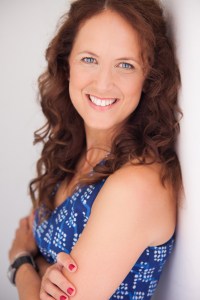 It is our great pleasure to announce that our author, Melissa A. Volker, will be participating in this year’s Montagu Book Festival, which is taking place on the last weekend in July. She will be speaking about romantic environmental fiction and her two novels, A Fractured Land and Shadow Flicker, on Friday afternoon (26 July).
Between 25 and 28 July, Montagu’s KWV Building Complex and the Old Mission Church in Long Street will host a variety of authors and panelists as part of the annual Festival.
The Festival kicks off on Thursday evening, 25 July, with an official opening address by Prof Jonathan Jansen. Other authors participating include Anne Dreyer Erasmus, Colin Johnson, Patricia Schonstein, Jacques le Roux, Theo Kemp, Don Pinnock, Karina M. Szczurek, Irma Joubert, Finuala Dowling, Tania Smit, David Grier, Wilhelm Verwoerd, Duncan Brown, Jopie Coetzee and Shirmoney Shamia Rhode.
Analysts, commentators and activists like Jan-Jan Joubert, Leon Schreiber, Christi van der Westhuizen, Carel Anthonissen, André Bartlett, Spiwo Xapile and Michelle Newhoudt Boonzaaier will participate in panel discussions about the political landscape after the general elections, challenges for the agriculture sector, and the future role of religious institutions in an increasingly secularised world.
A food-and-wine pairing with a cabaret-style show dedicated to the writings of Adam Small will cater for the discerning cultural palate.
Ticket prices: R150 for the whole weekend; R100 for a single day; R50 for a single session (individual author’s talk or panel discussion). These tickets prices exclude the food-and-wine pairing and Adam Small show, which will be priced separately.
Tickets are available from the Montagu-Ashton Tourism Association office at 24 Bath Street, Montagu. Tel.: +27 (0)23 614 2471

Karavan Press to publish Breaking Milk by Dawn Garisch
Karavan Press is delighted to announce that we will be publishing Dawn Garisch‘s seventh novel, Breaking Milk. This exquisite novel tells the story of a day in the life of an organic cheesemaker on a farm in South Africa.
The agreement has been signed and we expect to have the book out in September 2019.

Author: Dawn Garisch
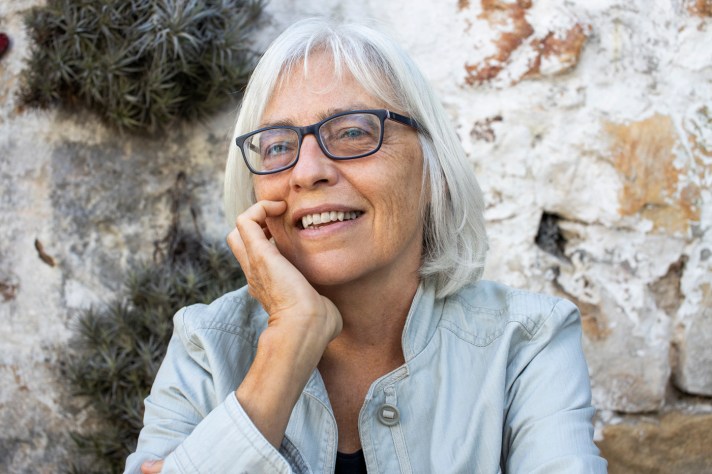
DAWN GARISCH is an author and medical doctor. She is a founding member of the Life Righting Collective (liferighting.com), running writing courses. She has had seven novels, poetry, short stories, a nonfiction work and a memoir published. She has had five plays and a short film produced, and has written for television. Her poem ‘Blood Delta’ won the DALRO prize (2007); Trespass was shortlisted for the Commonwealth Prize in Africa (2010); ‘Miracle’ won the EU Sol Plaatje Poetry Award (2011); and ‘What to Do About Ricky’ won the Short.Sharp.Stories competition (2013). Her novel Accident was longlisted for the Barry Ronge Sunday Times Fiction Award (2018), and her novel Breaking Milk was shortlisted for the Sunday Times/CNA Fiction Award (2021) and was published in the UK by Héloïse Press in 2024. Her first collection of short stories, What Remains, won the HSS Award for Best Fiction Short Stories and the Nadine Gordimer Short Story Award in 2024. The Consulting Room is her third collection of poetry.
Printing pains
Apologies to our author Melissa A. Volker and all our Readers, but because of a glitch in the printing process the delivery of A Fractured Land and Shadow Flicker to bookshops countrywide will be delayed. We hope it will be by only a few days. They are almost ready …
Author interview: Melissa A. Volker
‘You have to be present, mindful and in tune with the possibilities that lie before you on the page.’
– Melissa A. Volker
How and when did creative writing begin for you?
I’ve always loved reading, books and stories, but the first time I tried to write one of my own, it didn’t turn out to be the kind of writing I enjoyed reading. I was mortified and gave up immediately. But when I took a break from my career in beauty therapy, I decided to give it another try, this time with help. I took a creative writing course and it taught me that I still had a long way to go. I signed up for another one, and then another and things improved, but I still had no book. Finally, I signed up for a year-long supervised course, and the mere thought of the amount of money it cost forced me to write consistently until I completed the first draft of a full-length novel.
You write romance with a strong awareness of environmental themes. Please share with readers how important this aspect of your writing is for you.
I think we are all busy and get carried away in our day to day life and don’t realise the consequences of our lifestyle habits, like the use of single-use plastics. Maybe we don’t understand the complexities of some issues, like renewable energy, fracking or shark/human interaction. Even the seemingly innocuous things we take for granted with young children, like balloons and glitter, are not environmentally sound choices. While I don’t claim to have an in-depth knowledge of all these issues, I am acutely aware of them and try to make environmentally conscious decisions in my own life. I like to include these environmental themes in my stories to increase awareness in a way that the average person can digest and have a think about, without feeling disheartened. Maybe they will be moved to alter their thinking and habits? Maybe they will have a broader understanding of the issues from another point of view?


What is the greatest appeal of the romance genre for you as a reader and a writer?
I like happy ever afters. There is enough sadness in real life. And the one requirement of a romance is a happy ever after or a happy for now. (A love story, on the other hand, like The English Patient or The Notebook, does not, apparently, require a happy ever after.) I really love to feel the emotion with the character as a reader, and when I can feel my characters’ emotions as I write, I am equally delighted. I try to evoke positive emotion and feeling in a way that the reader can join in and become invested in the characters and the story.
How do you feel about the relatively new term ‘Up Lit’? Do you think it applies to your work?
I love the idea of Up Lit, of stories of kindness and of compassion. I am drawn to intelligent stories of people who have to get through quite serious issues, like emotional disorders or community problems, but they come out on the other side with hope. I think, because the world is so overtly divisive and fractured, regular people yearn for positive human stories to escape into. I do think my work is Up Lit, as my protagonists, although often flawed, ultimately treat one another with kindness and compassion, despite their differences.
In your stories, you create fascinating and independent women characters who overcome adversity with integrity and hope. Who are the women who inspire you and your writing?
My mother is a smart, organised, incredibly brave and positive person. She is a great reader and thinker, and has always just got on with the necessary business of life, despite adversity that might come her way. For the past fifteen years she has been doing that in the face of an incurable auto-immune disease. She presses on with such courage, love, faith, dignity and hope.
My maternal grandmother grew up in the United States, but in a notebook she gave me, she wrote that the happiest times of her childhood were when they had enough food. That stayed with me and after her death I found a lengthier memoir she had written. I was humbled and inspired to read a more in-depth account of the adversities she overcame to break with the cycle of rural poverty into which she was born.
You write about surfing on diverse platforms. Surfing also features strongly in your novel Shadow Flicker. Please tell us about the place this sport has in your life and work?
Is surfing a sport? Haha, I suspect it’s more of an obsession, a compulsion, much like writing, but possibly less plagued by self-doubt? I’ve been married to a surfer for more than twenty years, and initially I acquired a good beachside understanding of things. But four years ago, I stepped off the beach and learned to surf a stand-up paddle board. I have not looked back; I now plan my week around the surf report. Surfing is a most empowering experience; it has taught me that I am stronger and braver than I ever thought. I am grateful to have the opportunity to be in the water whenever it presents itself.

Significantly, the first editor who did NOT reject my writing was Calvin Bradley, of Zigzag Surfing Magazine. I entered a competition called Write To Surf, and wrote a story about my life as a surf widow called ‘The Thinking Girls Guide to Life with a Surfer‘. I didn’t win the competition, but they published the story online. It was my first ever published story and when it got over 1000 likes on Facebook I was beyond stoked. It’s been epic to subsequently write pieces for The Inertia, Zigzag and Wavescape, especially when I have had the opportunity to write about women’s interests in surfing. We have a bunch of smart and funny surf writers in South Africa and I enjoy reading their work and learning from them as well.
In some ways surfing is like writing. It’s almost impossible to impress your will upon a wave, instead you have to be in tune with it and adapt your movement to the possibilities the wave is revealing to you. Much like a story. Sometimes you can’t impress your will upon it or force it in a certain direction. You have to be present, mindful and in tune with the possibilities that lie before you on the page.
What other hobbies/interests are part of your everyday?
I’m a beauty therapist and operate a home-based salon. I am host to a cat who rules my life, and am raising two beautiful children who have quite busy schedules. They beat me consistently in Bananagrams and keep me up to date with new music trends. We are a spiritual family, so I try to take time to focus on that every day as well.

What did winning the Strelizia Award mean to you?
 I think most writers experience a bit of Imposter Syndrome, and I found that without an academic background I had little confidence in myself as a writer. When I first competed a version of Shadow Flicker, it was rejected by multiple publishers which was quite disheartening. But I pressed on, picking myself up after each rejection, getting advice and tweaking and rewriting the manuscript on multiple occasions. There was something inside me that kept telling me to keep going, not to give up. I really love the story and the characters and I knew if I could polish it properly, it would touch readers’ hearts. Winning the Strelitzia Award validated that. The very shiny, polished version of Shadow Flicker touched the judges’ hearts.
“The Romance is thoroughly believable and satisfying. It’s one of the best books I’ve read this year!”
“I especially enjoyed the very real South African setting and characters, the unique surfing background, and also that the hero and heroine and their conflicts were not clichéd.”
“It was fresh, well written.”
— ROSA’s Strelitzia Award Judges, 2017
What would you like your readers to take away from reading your novels?
Life is complicated but kindness and love are the bomb. I would like readers to feel good and happy after reading my novels and be open to making a positive difference in their corner of the world.
 karavanpress.com