Jonathan D Jansen reviews CONJECTURES: LIVING WITH QUESTIONS by James Leatt

James Leatt’s Conjectures: Living with questions (Karavan Press, 2021)

In this captivating and evocative new book, Conjectures, Professor James Leatt delivers a master class in how to think about and think through those perplexing questions that humans everywhere grapple with—questions of life and death, salvation and suffering, faith and doubt. Rich in literary references, the book is nevertheless accessible to a broad readership well beyond the landscapes of theology and philosophy that the author traverses with remarkable ease.

What makes this work particularly interesting is that Jim, as friends call him, teaches us about ‘living with questions’ (the sub-title of the book) through the biography of his rich and rewarding life, shared with us warts and all. The eldest child of a broken home (alcoholic parents), Jim finds the objects of his devotion in the Methodist Church and its sense of mission leads him to preaching in the backyards of my youthful upbringing (Retreat, on the Cape Flats) and ministering in the once promising community of Alice in the Eastern Cape before the apartheid government drained those small oases of non-racial living.

During his studies at Rhodes University, Jim begins to question the certainties of his faith as he engages some of the great thinkers of the 19th century on truth, knowledge, and human reason. It is his openness to challenging ideas and his courage in confronting unsettling questions that impress throughout the reading of this intriguing text. In the writing Jim gives us access to his head and his heart, and the slow but steady process of change that starts to transform his thinking about divine authority and the human condition.

Right in the middle of this contemplation, Jim shares insights into his roles as a leader of universities from Cape Town (UCT) to Durban (University of Natal) and eventually Thohoyandou (University of Venda) where, in the latter case, he led the successful transformation of a dysfunctional institution that is now regarded as one of the two or three historically black universities that have overcome the ideological and material deadweight of the apartheid burden.

Jim reassures the reader that he is not an atheist but one who has through his openness to ideas found his calling in ‘secular spirituality’ that values human connection, owns up to personal responsibility, lives compassionately, and revels in the ordinary. His “non-theism” inspired by Eastern thought, insists that we are on our own and that “there isn’t someone or something that is going to make things right for me …”

No doubt, the book will disturb those of us raised on foundational truths and the comforting certainties of fundamentalist faith. Fortunately, Jim does not set out to win over converts to his commitments but to invite readers into a world of conscious deliberation on vital questions about transcendent living that makes a difference in the lives of those around us. For that reason alone, Conjectures is highly recommended for these uncertain times where self-absorption, even mere survival, has displaced deep thinking about humanity, connectivity, and solidarity in an unjust world.

Jonathan D Jansen, Distinguished Professor of Education, Stellenbosch University

ISBN: 978-0-620935-87-6

Also available on Kindle: Conjectures

Moira Lovell reviews FOR EVERYTHING THAT IS POINTLESS AND PERFECT by Stephen Symons in the latest issue of STANZAS

“The thirty-six poems and prose passages that make up Symons’ new collection reveal the tender, sensitive and incisive vision of the writer.”

Stanzas 23 (July 2021)

“Wide-ranging, Symons’ work is both delicate and weighty. Full of subtleties and surprises, it arrests and engages the reader.”

FOR EVERYTHING THAT IS POINTLESS AND PERFECT by STEPHEN SYMONS

Samantha Malunga reviews LET IT FALL WHERE IT WILL by Lester Walbrugh

Follow Samantha on IG: @sammikoalareads

Rating: 5/5 🐨

Each of the stories spoke to me in a different way. Lester is a talented writer with great range. 

I’ll give some responses to my favourite stories from the collection: 

🐨BRILLIANT: 
For Better or Wors: Listen. THIS WAS MY FAVOURITE STORY IN THE WHOLE COLLECTION. You clever, clever story writer Lester. Brilliant. I honestly want to say please can everyone start with this excellent story first before reading any other one in the collection?

🐨HOME TRUTHS: 
Hairs and Graces: a story about the privileging of hair texture, and how falling in and out of love with one’s natural beauty. 

🐨MAGICAL REALISM:
In Skuins Street, Pisces Village, Hawston: a love story with a twist. This was executed beautifully and showed how lovers are linked. 

🐨REFLECTIVE:
The Epic is for Everyone: a story about how the real bad guy never gets caught and how it’s always the small fry that takes the heat in all things organised crime. This story really had me fuming, but it’s such an honest depiction of what happens in real life.

Homeful: It was a story of three homeless people tasked with taking a flash stick from an empty luxury home – but they stayed over for a few days instead of an in and out job. In the process, they look back on their past lives, and how they got to be in this current situation. It explored issues of colourism, relationship building and chosen families. 

The Colours Are Too Bright: this story is about a strained relationship between a mother and son, and how a person relates to their parents once they have left home. It was an incredibly sad story, and so well written, with a gentle blow at the end that you don’t expect at all. I loved this especially because it makes you re-read the story and pick up the hints along the way that you may not have seen initially.

✨Overall this was an excellent collection and I can’t wait to read more of Lester’s work. Thank you to Karavan Press for this reviewer copy and to Lester, for sharing your art with the world.✨

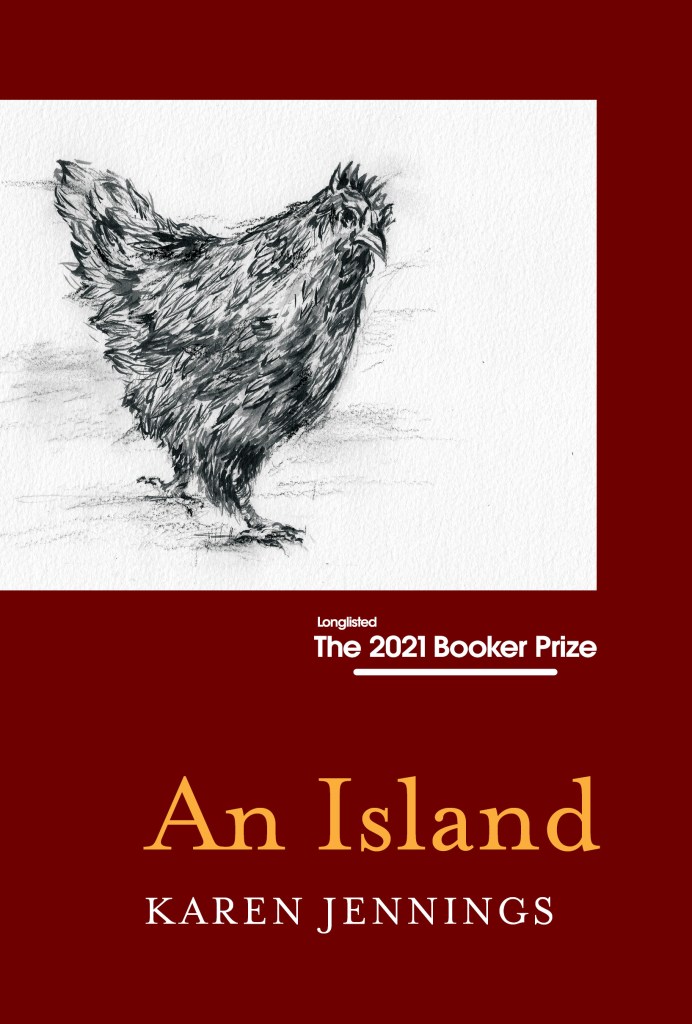
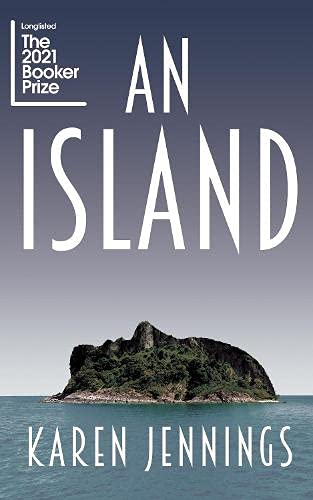
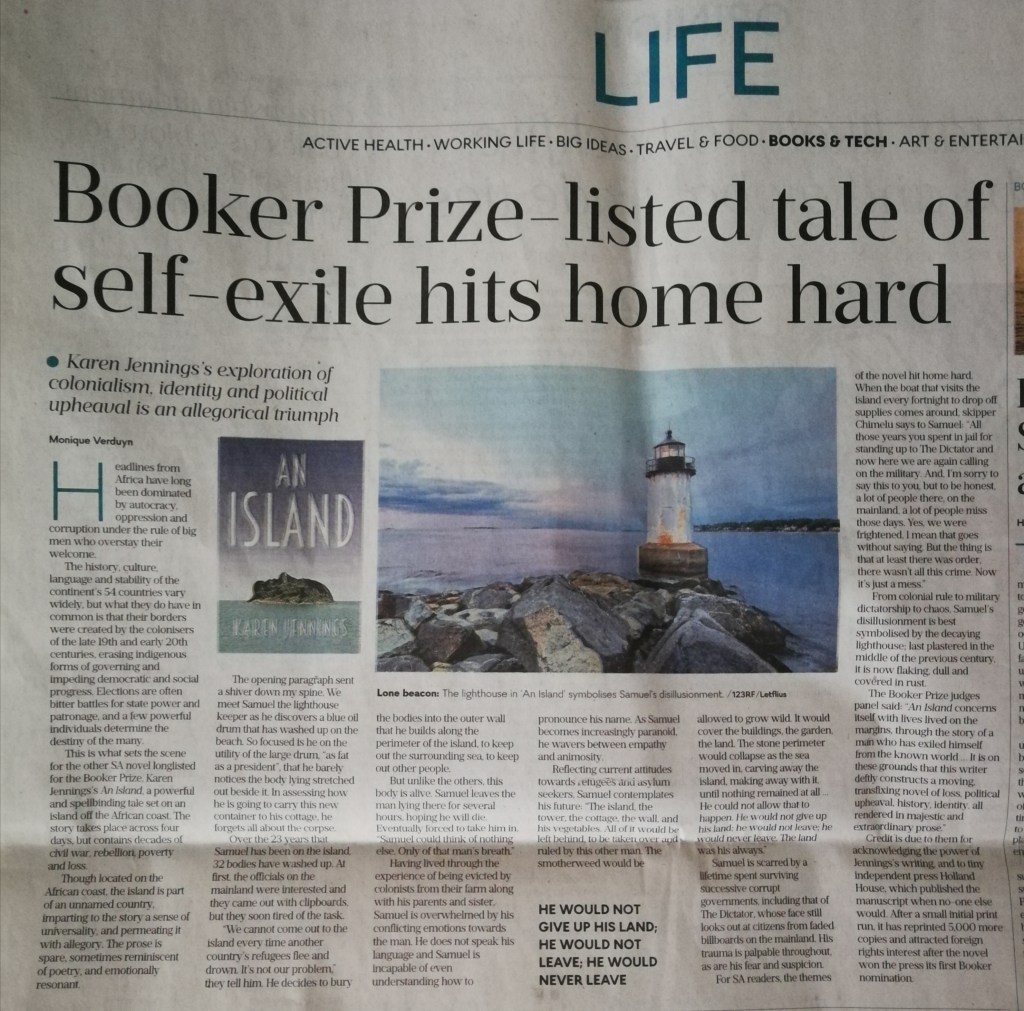
Catherine Taylor reviews AN ISLAND by Karen Jennings for the Guardian

“… A lighthouse keeper in self-imposed exile on a tiny island off the mainland, 70-year-old Samuel is disciplined in his daily habits and unchanging in his means of self-sufficiency. He carefully tends his vegetable patch, his only companions a clutch of chickens, with the favourite – an old, vulnerable, red hen – kept away from the vicious larger group. The ultimate fate of the hen and its part in the book’s sudden and violent conclusion lies in the future, but it’s clear that all is not serene on this island …”

Guardian

Christine Coates reviews AN ISLAND by Karen Jennings

An Island by Karen Jennings — everyone is talking about this book. There are other reviews but had to add mine!
It’s a small gem but also a great masterpiece. Very Coetzeesque. It reminded me of Disgrace. Just brilliant and by one so young. Her observation of human life and behavior is acute. I can’t get it out of my mind.
The author wanted to explore certain complexities relating to the history of the African continent and how that history continues to influence the lives of individuals to this day but the island could be anywhere — off Africa, off South or Central America, off the US, off Australia.

Goodreads

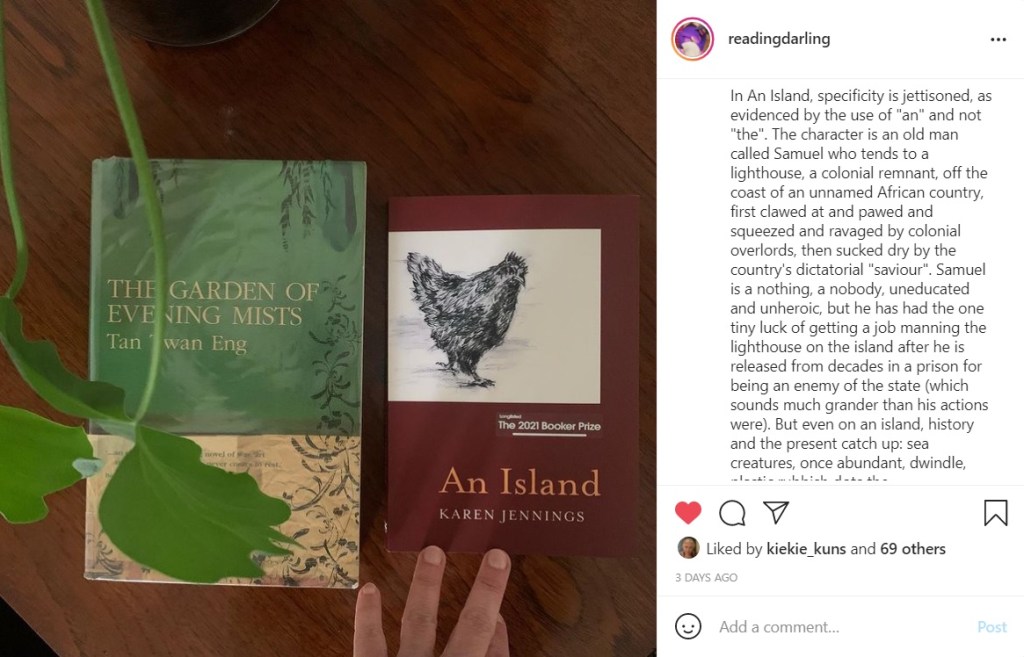
Karin Schimke writes about AN ISLAND by Karen Jennings

… In An Island, specificity is jettisoned, as evidenced by the use of “an” and not “the”. The character is an old man called Samuel who tends to a lighthouse, a colonial remnant, off the coast of an unnamed African country, first clawed at and pawed and squeezed and ravaged by colonial overlords, then sucked dry by the country’s dictatorial “saviour”. Samuel is a nothing, a nobody, uneducated and unheroic, but he has had the one tiny luck of getting a job manning the lighthouse on the island after he is released from decades in a prison for being an enemy of the state (which sounds much grander than his actions were). But even on an island, history and the present catch up: sea creatures, once abundant, dwindle, plastic rubbish dots the landscape…and bodies of refugees wash ashore. There is no escaping the world’s violence, malice, greed and selfishness. And there is no protection from what those do to the self. No man is an island. […]

An Island is bleak and stark, and Jennings writes in plain sentences. I read An Island in what would have been one sitting, had it not been for the interruption of night.

Karin Schimke Instagram

Woman Zone CT Review: AN ISLAND by Karen Jennings

“… But having cracked open the slender spine, I found it  to be even more unassuming and quiet – no prologue, no fanfare, no arcane dedication, hand-picked lines of poetry – even the acknowledgements are a mere eight grateful lines – but exquisite in its simplicity.
​‘The First Day’ announces the opening chapter – and with that you step ashore. Onto Samuel’s island. Where he’s been lighthouse keeper for over two decades. Washing up with you is a body – one of many that have found their way onto the pebbly and unwelcoming beach.
You come to know well, if not its exact whereabouts off Africa, the lie of the island, its nooks, crannies, secret spots. As well as Samuel’s sparse, isolated cottage where everything has its place. But you don’t stay there. Because as his memory is jolted by the arrival of this body, this man, Samuel’s reflections take us back into the dark, sometimes troubled past he was marked by on the mainland. Again, Jennings doesn’t pinpoint the exact times and places of this not so long ago time but if you live towards the tip of Africa, you can feel it in your southern bones. Smell it in her carefully chosen words. By ‘The Fourth Day’, I was all but holding my breath.  
I’m ashamed to have taken so long, but richer for reading such a thoughtful book, with a punch way above its weight.” 

Woman Zone CT