Joy Watson reviews Death and the After Parties by Joanne Hichens

Joanne Hichens’ Death and the After Parties is a story about what happens when we lose someone we love and we’re broken beyond repair.
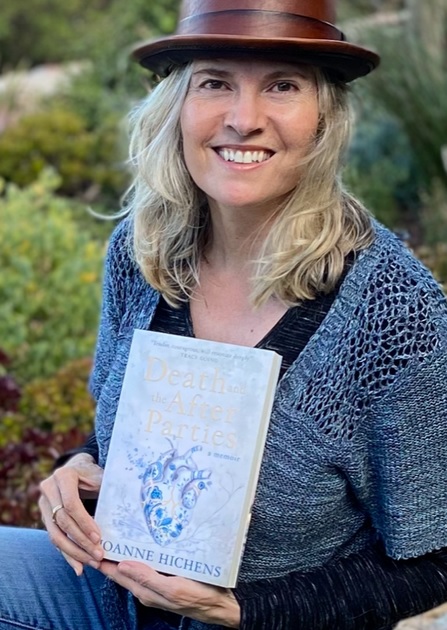
Joanne Hichens

Two weeks into lockdown, my Dad took ill. A month later, he was dead. In the months that followed, I spiralled into a dark pit of nothingness. Consumed by loss, I journeyed into the underworld, my only solace being stories about death. This is how I came across Joanne Hichens’ Death and the After Parties – a story about what happens when the matrix shifts – when we lose someone we love and we’re broken beyond repair.

Hichens writes, ‘How do we keep in mind how fast time diminishes for us, that the years left become a smaller and smaller percentage of time compared to what we have already lived?’

This is at the heart of the book – the fact that time is a narrow bandwidth. We live. We love. We lose loved ones …

Continue reading: Daily Maverick

DIANE AWERBUCK reviews DEATH AND THE AFTER PARTIES by JOANNE HICHENS for the Sunday Times

THE KISS OF DEATH

The aptly titled Death and the After Parties is Joanne Hichens’s long-awaited memoir following four sudden horrifying deaths in her family. Blisteringly accurate, humorous and lyrical, the book follows her investigations into how we mourn, and how she nearly lost herself in that process. Hichens initially began a scholarly dissertation on grieving soon after her mother’s death, titled “Loss and the City”, which examined Cape Town’s tortured past and present – the losses of land and identity. Then her husband died, and her theory was proven in hard and personal practice.

The passing of seven years since his death has given Hichens a clarity of thought even in the ongoing chaos and fever of grief. The memoir is divided into five parts, a kind of guide to grieving.

Continue reading: Sunday Times

Mignonne Breier’s comments on Breaking Milk and the ‘physicality’ of Dawn Garisch’s writing

Breaking Milk cover

I wanted to express what I find unusual and fascinating about your writing – which this book seemed to exemplify – and I needed to think about it. I know you talk about ‘embodied’ writing. I am not sure exactly how you define that, but having read six of your books now I am going to try to articulate what I think is the ‘physicality’ of your writing.

I think your writing takes one to the edges of human experience and tells us what it is like to be there. Your knowledge of the human body makes it possible for you to describe what one can barely imagine – being the mother and grandmother of conjoined twins in this case – and tell us what it is like, in a physical as well as emotional way. (Other examples: the relationship between Phyllis and the young boy in Trespass, and the ‘accident’ in Accident). Your writing takes one to the edge of what many of us have been taught to regard as acceptable subjects to speak or write about. You write as elegantly about urinating and defecating, sex and orgasms as you do about mountains and music and ideas. Breaking Milking also seems to be particularly well-researched, yet one never gets a sense of the labour that must have been involved. You write as if you were a cheesemaker yourself!

I continue to be a great admirer of your writing.

Dr Mignonne Breier is an author and academic based in Cape Town.

(Personal note posted with permission of the author.)

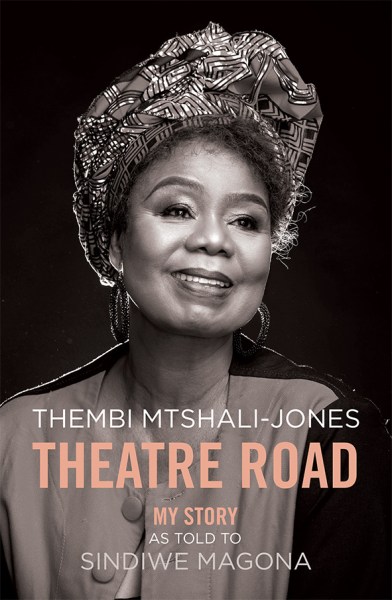
Nancy Richards reviews Theatre Road for Breakaway Reviewers

THEMBI_COVER_FINAL_LOWRES

From domestic worker to diva – a truly South African story

“To a greater or lesser extent all biographies, auto or otherwise, tell the story of the times as much as that of their subject. In Ms Mtshali-Jones case, her story reflects the anomalies and atrocities of apartheid as well as her own journey through theatre. But to begin at the beginning, young Thembi, born of a childlike ‘makoti’ (new wife) grows up in rural Kwa Zulu-Natal with her grandparents. Her early childhood is simple, honest and filled with old school love and care. Things change though when aged 13 she is put on a bus to join her mother in Durban where her eyes are opened wide – and she sees white people for the first time…”

Continue reading: From domestic worker to diva – a truly South African story

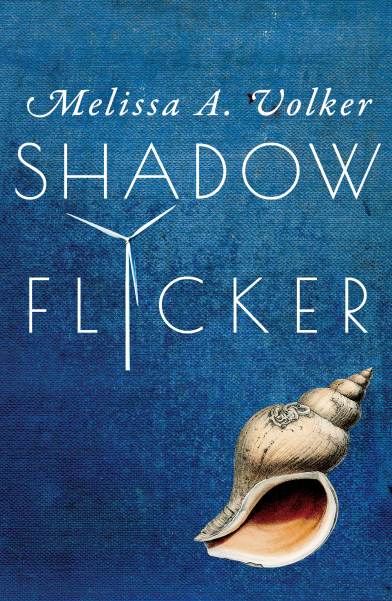
Andy Martin reviews Shadow Flicker by Melissa A. Volker

Shadow Flicker_LR for web

“I should declare an interest. I have a special fondness for the part of South Africa where this novel is set: in and around St Francis Bay on the Indian Ocean side, down the road from J Bay, boasting some of the best waves in the world. And like everyone else I have an interest in trying to save the planet. So I am naturally drawn to a novel that pulls together a beautiful and moody coastline, a handful of lonely, messed-up characters, and a plan to build a wind farm. But, I’ve got to say, Shadow Flicker beguiled me way more than I could have expected. It’s a love story with a noirish edge …”

Read the entire review here: Goodreads

Surf Sweat and TearsAndy Martin’s is the author of the upcoming Surf, Sweat and Tears: The Epic Life and Mysterious Death of Edward George William Omar Deerhurst.

“I don’t normally read books about surfers, but this is like Truman Capote, with shorts.” — Lee Child

Earl Nicholas Petersen reviews Breaking Milk by Dawn Garisch

Breaking_Milk_Dawn_Garisch_COVER_SMALLI have just completed reading Breaking Milk and I enjoyed it completely. It was a rollercoaster ride in the best way. At first I was less intrigued by the story and more fascinated by the style of writing, it truly is poetic in the analogies that are drawn and the way Dawn describes the surroundings, people and feelings. After a while I became accustomed to the style of writing (still fascinated by it though) and then I was absorbed into the story. But towards the end the most riveting aspect of the book became the understanding and expression of the human condition by the author.
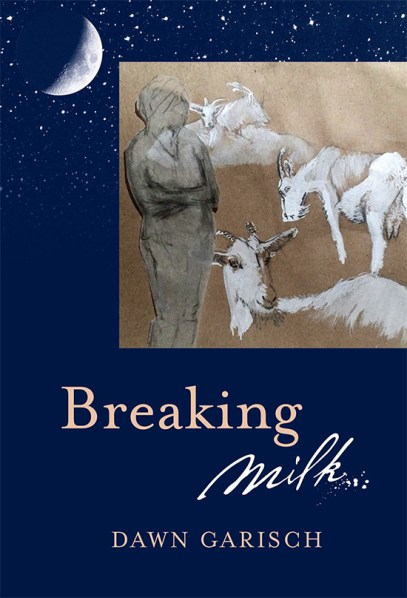
Breaking Milk left me feeling unbroken and light. It reaffirmed my notion that nothing really matters in the bigger scheme of things and that in as much as we consider ourselves significant and often make mountains out of molehills, we are actually quite insignificant in the universe, which is reflected by the ejaculate of the Milky Way over the moon on the book cover and as described in the text. The vocabulary used is really excellent and I needed to consult a dictionary from time to time which I didn’t because I was enjoying the book so much and I could make sense of the words in the context of the sentences. I also particularly like the absence of quotation marks because it allowed everything to flow so well. I really enjoyed how the text broke away from the story by working in philosophies and theories during a portion of the written work where Kate has a conversation with her goats.

I must admit that I was waiting for something raunchy to happen and the writing didn’t disappoint, even if the performance by one character wasn’t exactly up to par. Once again, the way it was captured was mesmerising.

I thoroughly enjoyed this book along with the journey and emotions it led me on and to.

Thank you to Earl Nicholas Petersen for sending this wonderful review.

Tracey Farren reviews Breaking Milk by Dawn Garsich

Breaking_Milk_Dawn_Garisch_COVER_SMALLI fell into Kate’s voice, wise with middle-age, cuttingly honest, panic-stricken. The elegance of the prose seduced me away from my secular life into a full day with an ex-scientist who has taken up cheese making in the country. As I hung out with Kate during a critical day in her life I felt her rage against man’s abuse of nature; her denial, her screaming anxiety about her baby grandchildren. I felt her hand in the vat as she breaks the milk over and over, refusing to admit that she is a nervous wreck.

‘Don’t come!’ Her daughter has said, beseeching Kate to keep her distance when she should want her mother close. This day is the day when her daughter’s conjoined twins are being separated at the brain by a surgeon’s knife.

Breaking Milk is a book about the things that should be separated to survive and that which should never be split. It’s about convictions and opinions and how human interaction can derail them in an instant. As hard as Kate tries to cling to her principles, real life arrives and knocks her off her cerebral center again and again. The ambushes are fantastic, building pressure in ways I would never have guessed. These interactions are preposterous, often hilarious but you feel the twist of the knife at the same time. Kate’s flashes of instinct screw with her logic until, I can tell you now, things get hot. Anatomical, you might say, in a non-medical sense. As Kate struggles to steer her cognition I felt my own thoughts breaking up and reforming in a different shape. ‘Don’t be surprised if you surprise yourself’, the book seems to be saying. It’s hard to explain.  Read it, you’ll see what I mean.

Review first posted on the GBAS FB page.

Robyn Y. Cohen reviews Theatre Road

The Cape Robyn

Arts and lifestyle writer Robyn Y. Cohen reviews Theatre Road, Thembi Mtshali-Jones’s story as told to Sindiwe Magona:

THEMBI_COVER_FINAL_LOWRES

“A big surprise for me in reading Theatre Road is that it operates along two converging points. There is the Thembi Mtshali-Jones story – how she made her way from domestic worker to international star on her personal theatre road. And there is the story of the theatre road of Black artists in South Africa and how they have been – and in many instances continue to be –side-lined in terms of recognition (creative and intellectual property) and remuneration.”

“Absence and presence resonate powerfully in reading in Theatre Road and will stay in my mind – long after learning about the details of Mtshali-Jones’ life. From an early age, she dealt with the absence of her mom who was a domestic worker. She was not absent by choice but circumstance of Apartheid which forced her to be separated from her child in order to earn a living. Until she was 13, Mtshali-Jones saw her mom only about once a year. She stayed with her grandparents. Although her mother was not physically there, she was very much a loving presence and this is conveyed deeply by Mtshali-Jones in this book. Her father was generally absent. He was keen to get back into her life when she was famous. His absence was felt but it didn’t define her life and she didn’t shroud herself in anger and resentment.”

Click here to read the entire review: The Cape Robyn

Kate Sidley reviews Breaking Milk by Dawn Garisch for the Sunday Times

A small world of deep metaphorical meaning

There is a lot in this slim book – art and science, family and culture, the workings of the heart and of the body

Review by Kate Sidley

On a farm in the Eastern Cape, Kate wakes before dawn, her head and heart in turmoil. She has good reason to worry – today is the day that her baby grandsons, conjoined twins, are to be separated. The risky surgery will take place in London. Kate’s estranged daughter, Jess, has told her definitively, and hurtfully: “Don’t come.”

On the same farm, Nosisi awaits the return of her son, who is undergoing the traditional initiation into manhood. Another anxious mother, another separation, another child at risk.

“So many women down the ages have lain awake in the earth’s great shadow, insomniac over their progeny, their sons and daughters intent on escaping their mothers’ intractable worry,” writes Dawn Garisch in Breaking Milk.

The book takes place over one day, from Kate’s early-morning wake up, and within the confines of the farm and the house she shares with her demented father and his carer. As she ponders her painful choice – respecting her daughter’s wishes, or rushing to be at her side – she must continue to take care of business. Once a microbiologist geneticist working on embryos in a fertility lab, she is now the creator of prize-winning goat’s cheese…

Continue reading: Sunday Times

LitNet’s Yolanda Wessels reviews Shadow Flicker by Melissa A. Volker

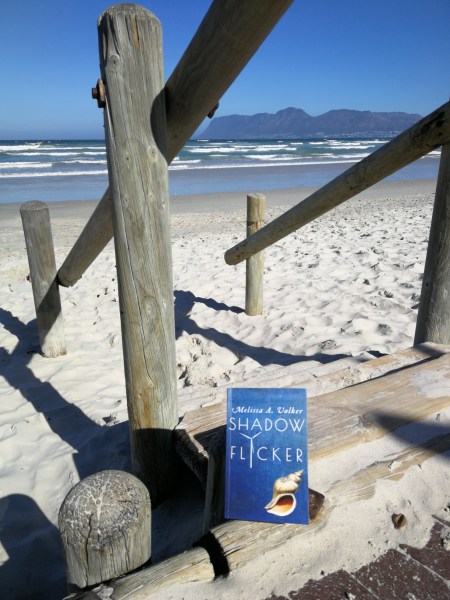
Shadow Flicker on Muizenberg BeachShadow flicker vertel die storie van Kate Petersen wat leef vir haar werk, veral omdat haar persoonlike lewe ’n gemors is ná ’n lewensveranderende gebeurtenis. Sy vertrek na St Francisbaai in die Oos-Kaap, waar sy die boere moet oorreed om hul grond beskikbaar te stel vir die ontwikkeling van hernubare kragopwekking. Dit is haar keuse om nie haar baas in te lig dat sy terugkeer na die plek waar haar probleme ontstaan het nie – ’n tragedie wat steeds by haar spook en die oorsaak van haar paniekaanvalle is.

Hier ontmoet sy vir Dr Matthew Sykes, die dorp se veearts, wat steeds in rou is oor die ontydige dood van sy omgewingsgoedgesinde vrou. Alhoewel sy geensins beplan het om emosioneel betrokke te raak nie, ontwikkel dié twee spoedig ’n sagte plek vir mekaar. Ongelukkig is die pad nie net met rose besaai nie en behalwe vir die vyandigheid wat in die kusdorp uitbroei, word Kate die slagoffer van inwoners met verskuilde agendas…

Continue reading: LitNet