

Please click here for more details: African Centre for Cities
Please click here for more details: African Centre for Cities
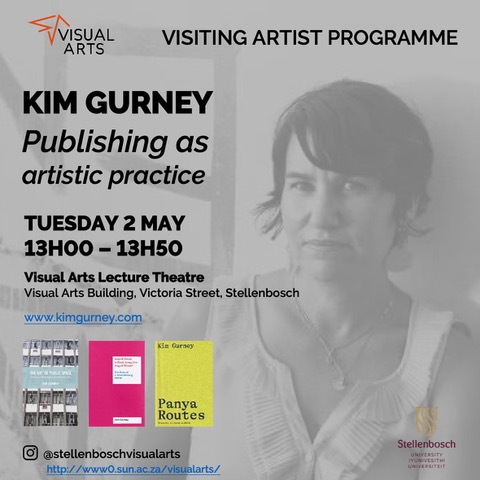
Since 2015, Kim Gurney has published from arts-based research three books where contemporary art tells larger stories about the urban everyday, collective life, and social imaginaries, with a fourth in the works for 2023. These have generally focused upon ‘offspaces’ – exploring public space in Johannesburg inner-city through walking, new media and performance art; the artistic inner life of a studio building in existential limbo; the working principles of non-profit project spaces on the continent; and the invisible labours revealed by a back room institutional archive. Kim will share the processes behind assembling publications as creative outcomes which aim to perform the subject matter, and the challenges involved.
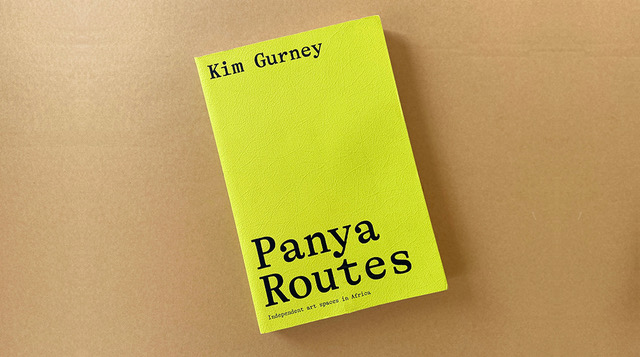
The books referenced in this talk are: The Art of Public Space: Curating and Re-imagining the Ephemeral City (Palgrave Macmillan, 2015), August House is Dead, Long Live August House – The story of a Johannesburg Atelier (Fourthwall, 2017), Panya Routes: Independent art spaces in Africa (Motto, 2022), & Flipside – The Inadvertent Archive,which is currently in production with iwalewabooks (Bayreuth, Lagos & Jhb).
Dr Kim Gurney is based at the Centre for Humanities Research, University of the Western Cape, where she has been investigating sites of counterfactual imagination – independent art spaces, back room archives, and artisanal workshops. She brings a fusion of fine art, urban studies, and journalistic expertise together, favouring arts-based methods and experimenting with narrative forms. Her own art practice largely concerns disappearances of different kinds and makes restorative gestures – spanning studio work, public art, discourse and curation. She runs ad hoc a nomadic platform guerilla gallery; in 2023, it inhabits The Shed – a tiny space for big ideas. Kim has extensive experience as a writer and former editor in different genres, currently focused upon book projects.
Kim’s Panya Routes and August House is Dead, Long Live August House – The story of a Johannesburg Atelier are distributed by Karavan Press and Protea Distribution.
To close the WZ Book Club year of 2022, the readers went down to the sea, to Beach Blanc Cafe next to the lighthouse on Woodbridge Island to hear the story of The Skipper’s Daughter by Woman Zone founder Nancy Richards and published by Karavan Press. Nancy was in conversation with artist Kim Gurney, the author of a book called Panya Routes. Listen here for some salty tales!
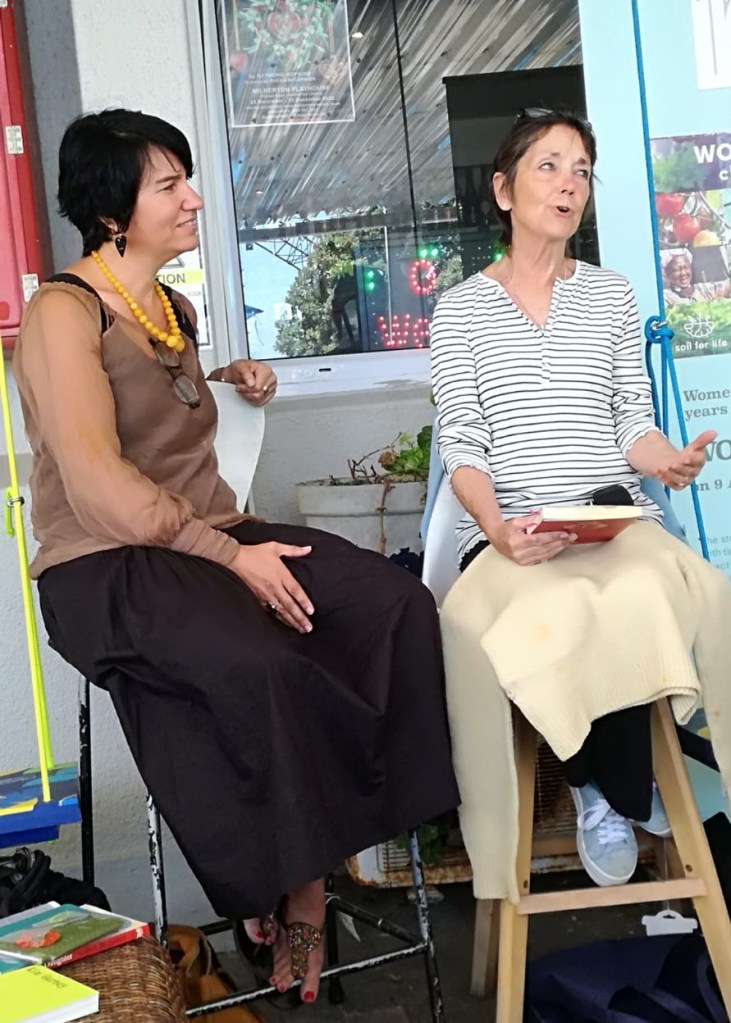

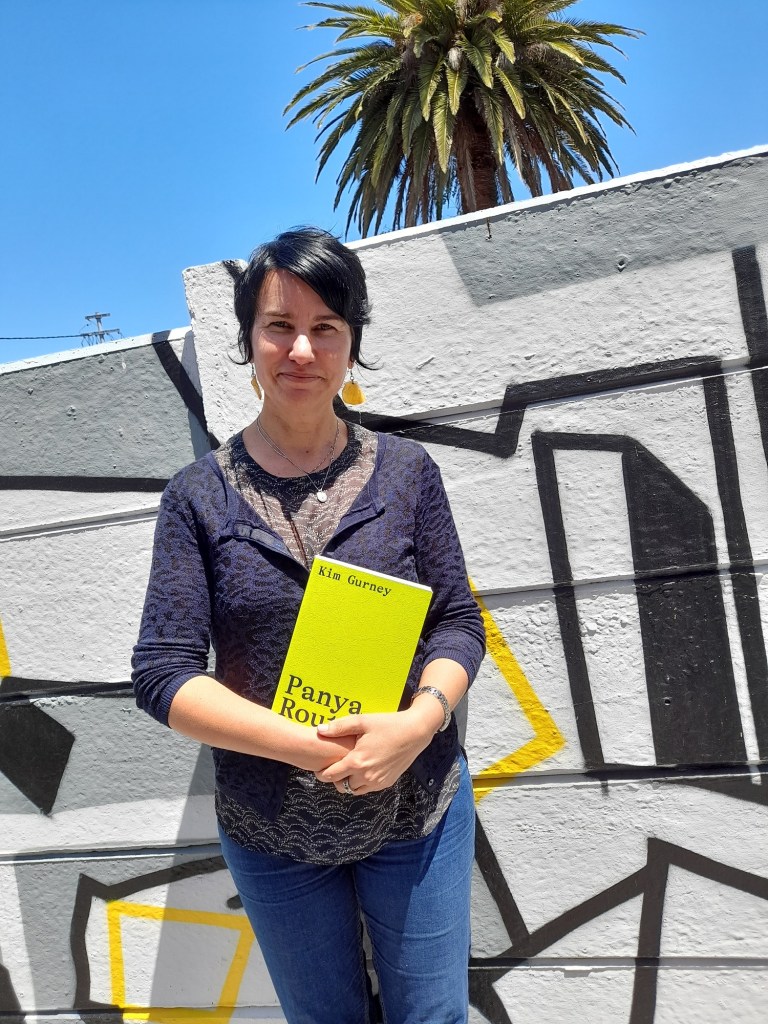
Artist, academic, writer Kim Gurney visited five different Independent Art Spaces in five different African cities: Nairobi, Accra, Addis Ababa, Cairo and Dar es Salaam. She came back with a changed mind, fresh thinking and some very different outlooks on the future, of art, cities and society in general. The result, a book to change your mind too, called Panya Routes (Motto).
Listen to her interview with Nancy Richards: KIM GURNEY – On ‘Panya Routes’

One of the creatives Kim Gurney interviewed for her latest book, Panya Routes: Independent art space in Africa (Motto Books, 2022), Nana Oforiatta Ayim, the founder and director of the ANO Institute of Arts and Knowledge in Accra, said that she “wanted to set this place up so that others like me who wanted to write and express something could come and have a home, a place to think collectively, create, push boundaries.”


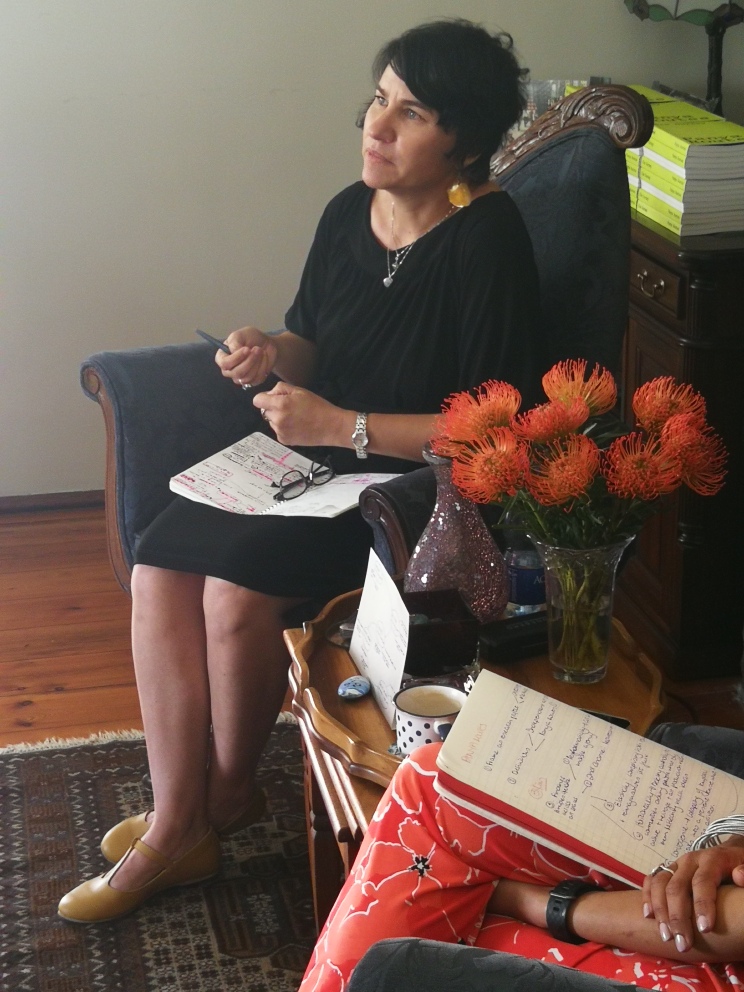
Earlier today, Kim was in discussion about Panya Routes with Joy Watson – both belong to the Rosebank Writes group, recently founded by Kim and other writers who live and work in and/or are affiliated with the suburb of Rosebank, Cape Town (we have a sister organisation in Johannesburg). The event was hosted by another member, Shireen Mall, in her beautiful lounge that was transformed into an independent art space for the day. Writers, readers and creatives gathered to celebrate the publication of Panya Routes (which Karavan Press and Protea Distribution have the honour of distributing in South Africa along independent panya routes of their own) and listen to Kim and Joy discuss the book, its origins and consequences.


It was a morning of illumination, and I cannot thank Kim, Joy, Shireen and all who attended, enough for inspiring us all to search for our individual panya routes which allow us to be creative in spaces where, in the words of Ngũgĩ wa Thiong’o, “the progress of any one person is not dependent on the downfall of another” (quoted in Panya Routes).


Please join us for this exciting Rosebank Writers event on the 29th of October! All welcome, but please RSVP for catering purposes.


Kim Gurney, the author of Panya Routes: Independent art spaces in Africa, is participating on a public panel in Cape Town on Saturday about the politics, legacies and inheritances of independent spaces. Along with:
Date: 24 September
Time: 12h00-14h30
Venue: Theatre Arts Admin, Observatory
The panel is part of ‘Power Talks’, convened by Goethe-Institut Johannesburg and African Centre for Cities, as a roving national series to unpack power mechanisms in the cultural world. The Cape Town iteration is curated by Ukhona Ntsali Mlandu, director of Greatmore Studios, to look beyond the trauma and violences of power and see what constructive manifestations of power might look, taste, sound and feel like. It involves sonic explorations, food networks, theatre explorations, and more.
Event info here: www.instagram.com/powertalksza/
Session info: https://www.instagram.com/p/CixX5wDKdQJ/
Website: https://www.goethe.de/ins/za/en/kul/sup/pow/cap/events.html#i8640482


Last week Thursday, Panya Routes: Independent art spaces in Africa by Kim Gurney was launched at the A4 Arts Foundation. Kim was in conversation with Neo Muyanga.

“I travelled to five cities on the African continent at intervals during 2018 and 2019 to visit an independent art space in each. Panya Routes is an invitation to join this journey and discover how such spaces work, think and navigate conditions of constant flux. These independent art spaces form part of a larger family of small-scale platforms, often artist-led or with artistic thinking at heart, whose numbers have flourished in recent years although their existence can also be short-lived. This book focuses upon five case studies of such spaces that have all been active for more than a decade, thus offering compelling tales about sustaining non-profit and innovative practice in an increasingly commodified world. My visits, conducted as part of the African Centre for Cities research project Platform / Plotform, were timed to coincide with emblematic programming, predominant art in public spaces. And, where possible, other independently curated events and spaces from a street art festival to an “off-biennial” were considered in parallel in order to glean another reading on art in each city …” (Panya Routes, p. 9)
Thank you, Nancy Richards and Natalie Becker, for the photographs!


 karavanpress.com